The Wall Has a Curfew: Street Art That Only Shows Up After Midnight
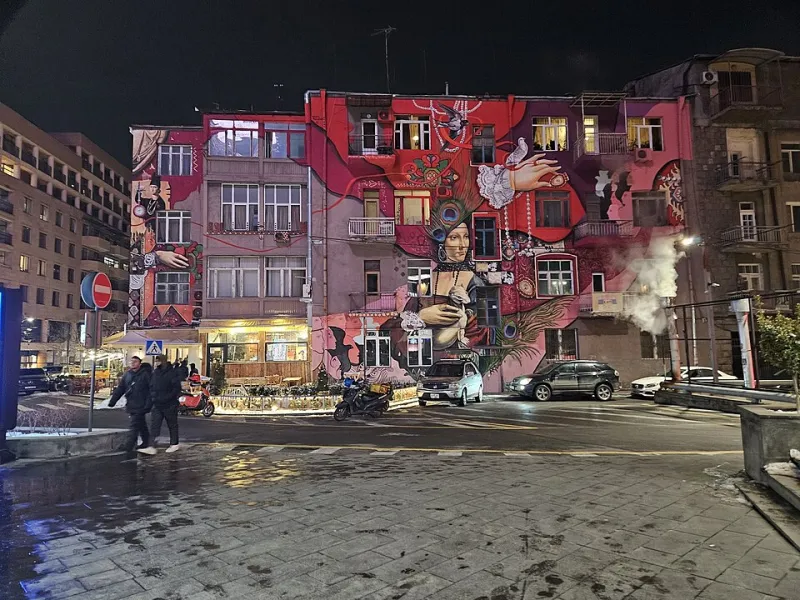
Photo: Furkan Akkurt, CC BY-SA 4.0, via Wikimedia Commons
At 11:58 p.m. on a cool October night in Bushwick, a small group stands in front of a rolled-down loading gate and stares at their phones. The gate looks ordinary: scuffed metal, a few old stickers, a ghost of a wheatpaste rectangle. Then the clock ticks to midnight. On-screen, a tangle of animated lines crawls across the gate, wraps around a fire escape, and blooms into a full mural that is not painted anywhere. For the next 47 minutes, the wall is alive on phones. Then it vanishes.
This is the basic move behind a growing set of time-locked augmented reality murals in US cities. Crews paint a base layer — sometimes a faint glyph, sometimes nothing at all — and attach an AR experience to a geofence with a schedule. The piece only unlocks inside a tight radius during specific hours. No app store scavenger hunt, no always-on layer sitting in the feed. Just a wall that keeps office hours.
The Timer Is the Medium
The technical setup is less exotic than it sounds. WebAR links, QR codes, NFC tags, and lightweight browser anchors have made location-based layers cheaper and more reliable than they were even a couple of years ago. A crew can hide a small marker on a wall, register a geofence, and set a window: midnight to 1 a.m., or dawn to 7 a.m., or the first Friday of every month. The wall becomes a venue with a door policy.
What is new is the intent. For a lot of artists, the always-on AR layer started to feel like spam. If every sticker and mural has a permanent digital twin, the street becomes another content surface — endlessly available, endlessly indexed, endlessly scrolled. Time-locking flips that. It makes the wall a scheduled event. You cannot see it on your lunch break just because you are nearby. You have to know, show up, and catch it.
That scarcity is the point. Crews in Detroit, Los Angeles, and Philadelphia describe the midnight unlock as a way to reclaim surprise from the feed. A mural that appears for 45 minutes has more in common with a warehouse show or a flash mob than with a tourist attraction. It rewards the people who are already out, already looking, already in the know.
Scarcity vs. the Feed
The appeal is easy to understand. Street art has always had a tense relationship with documentation. A piece can live for years in photos and disappear from the wall in a weekend. Time-locked AR adds a second clock. The paint might stay, but the digital layer has a curfew. That makes the phone experience feel less like a permanent exhibit and more like a performance.
It also creates a different kind of story. People who catch a midnight unlock post about it the next morning, but the post is not the artwork. It is a receipt. The piece has already gone dark. That delay is healthy in a media environment where the documentation often arrives before the paint is dry. It pushes the audience back toward the physical site, even if the payoff is on a screen.
There is a practical upside for artists, too. A scheduled layer can be changed, rotated, or retired without touching the wall. A crew can run a series of one-night AR interventions on the same surface and never repaint it. For projects that depend on permits, landlord tolerance, or plain old stealth, that flexibility matters. The wall stays quiet. The layer does the talking.
Who Gets Locked Out
The uncomfortable part is access. A mural that only appears from midnight to 1 a.m. is not public in the way a painted wall is public. It is public if you have a capable phone, a data connection, the right link, and the freedom to be in that place at that hour. That leaves out plenty of people: night-shift workers, parents with young kids, people who do not feel safe on a dark block, tourists who flew in for a weekend, anyone with an older device or a limited data plan.
Artists I spoke with are aware of the trade-off. Some argue that street art has always been exclusionary in its own way — hidden spots, insider knowledge, crews that do not broadcast every move. A timed unlock is just a more explicit version of that. Others are less comfortable with it. One organizer in Chicago described the midnight model as a cool experiment with a bad accessibility profile. She now runs a daylight window on the same wall once a month so that the piece is not only for people who can stay out late.
That tension is probably where this format grows up. The most interesting projects are not simply hiding the work. They are designing multiple doors: a short midnight unlock for the heads, a longer weekend window for the neighborhood, a low-bandwidth fallback that still shows something. Scarcity can be a creative choice. It becomes a problem when it is the only choice.
The City as Calendar
What strikes me most about these projects is how they change the feel of a block. A wall with a scheduled layer is no longer just a surface. It is a time zone. People gather before the unlock the way they might gather for a projection show or a pop-up. The phone becomes a ticket, but the street is still the room.
That is the Grafedia lens in a nutshell: street art meets the mobile feed, but not by flattening one into the other. The wall does not become a screen. The screen becomes a way to visit the wall at a specific moment. In a city that already runs on appointments, reservations, and timed-entry everything, it is a little funny that the most underground use of AR is basically a scheduled viewing. But it also makes sense. Attention is the scarce resource. Time-locking is one way to make people spend it deliberately.
What Comes Next
The format is still small, and it is not hard to imagine it getting co-opted. A brand could run a midnight unlock. A real estate developer could use a timed AR piece to make an empty lot feel alive. A city could turn it into a permit category with a curfew and a fee. None of that would kill the idea, but it would change it.
For now, the crews doing this are mostly experimenting in public, which is the right place for it. The midnight unlock is a bet that people will still show up for something they cannot see whenever they want. It is also a bet that street art can use the phone without becoming content. The wall has a curfew. The question is whether the rest of us are willing to wait.