Dead Zone Aesthetics: The Crews Painting Walls Your Phone Can't Read
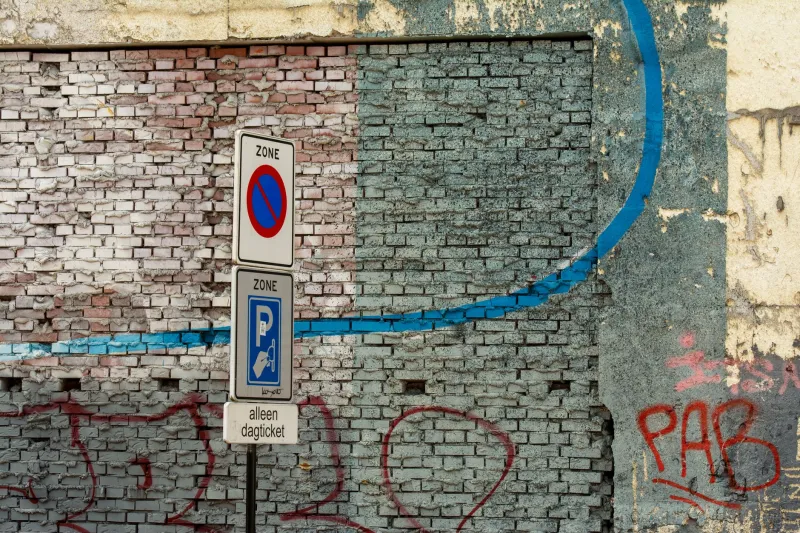
On a cool Saturday in October, a few dozen people stood in front of a wall on Columbus's east side and did the thing almost nobody does at a mural anymore: they just looked at it. No phones out. Nobody crouching to frame the little square in the bottom corner. The piece — forty feet of chalky matte blue with a swan drawn in one dusty line — had nothing to scan. No QR block, no AR target, no hashtag tucked into the negative space.
That was the point. The wall was built to fail your camera.
How you make a wall invisible to a phone
The technique is less mysterious than it sounds, and every artist I talked to described roughly the same playbook.
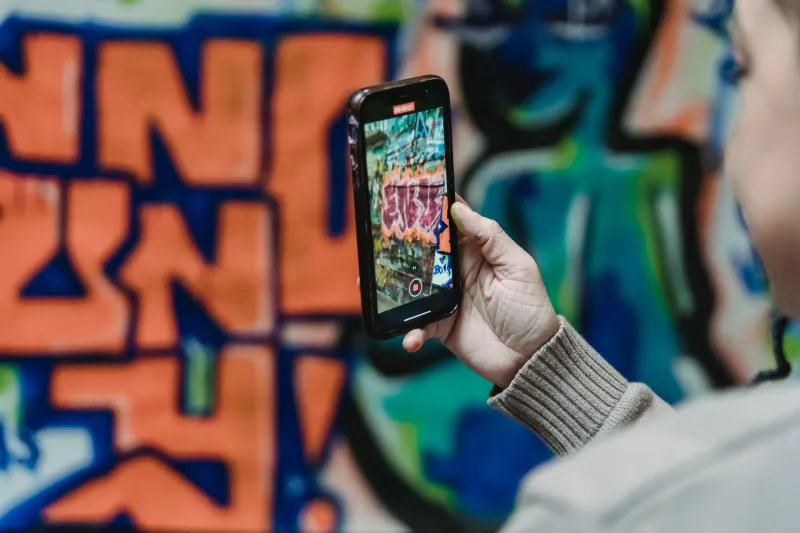
Start with contrast. A QR code lives or dies on a hard edge between dark and light modules, so the Columbus crew painted their entire wall inside a narrow range of values — slate blues, gray-greens, a swan the color of old ice. An AR trigger needs distinctive feature points to lock onto, so the surface was laid down with a high-frequency texture: stippled, scumbled, ridged with a roller that left visible nap marks. From ten feet away it reads as calm. To a tracking algorithm it's a thousand near-identical features arguing with each other until the overlay gives up.
Then there's the finish. A sheen throws specular highlights that break image matching at oblique angles, so the crew went flat matte and stayed there, sealing the piece with a dead-flat varnish that eats light. And scale does the rest. Even if someone painted a code onto a wall this size, the modules would be too small to resolve from the sidewalk — which is where people actually stand.
"If your camera can't find it, we did the job," said a painter who goes by Halftone, one of five members of Quiet Hours, a crew split between Columbus and Dayton. "We're not anti-phone. We're pro-standing-still."
The crews doing it on purpose
Quiet Hours has painted four of these so far, all in 2026, all commissioned by small businesses that could have asked for a scan layer and didn't. Their rules are informal but firm: no markers, no codes, no logo smaller than a fist, nothing that rewards a screenshot over a stare.
In Tucson, a two-person outfit called Low Beam takes a different route to the same dead end. Their walls are built around sun angle — deep matte earth tones that go almost flat between eleven and two, when the desert light is brutal and phone cameras are desperate. Their best-known piece, on the side of a bike shop, has been photographed thousands of times and successfully scanned, as far as anyone can tell, zero.
"Every other wall in this city is trying to get you to open something," one of the Low Beam painters told me. "Ours is trying to get you to close something."
What unites the crews is a shared irritation with what murals became once every wall got a second, invisible layer stapled to it. A painting stopped being a thing you look at and became a doorway you're supposed to walk through. The unscannable wall is a small, stubborn vote for the painting.
The venue owners betting on friction
A bar owner in Kansas City's Crossroads district pulled the QR plaque off his patio mural in the spring and replaced it with a laminated card that just lists the artist's name. "People were standing two feet from a nine-thousand-dollar painting looking at a drink menu," he said. Since the plaque came down, he claims the wall gets more photographs, not fewer — and the ones he sees online are wide shots of the whole piece instead of tight crops of a code.
Not everyone is sold. A developer in Baltimore wanted scan-to-lease overlays on three murals in a new courtyard; the artist pushed back, they compromised on one scannable piece and two that aren't. "I don't think anyone's losing sleep," the developer said. "But I do think the offline wall is becoming a selling point, which is funny, because it's the opposite of a selling point."
That's the tension worth watching. A refusal can be a stance or a brand. A Columbus coffee shop is already printing "unscannable" on a tote bag, which is either the end of the movement or proof that it has legs.
The case against the dead zone
There's a real critique here, and it doesn't come from the tech side. A mural consultant who works with accessibility groups pointed out that scan layers aren't only marketing. They carry audio description, translation, artist statements, and context for people who can't get close to the wall or can't see it at all. A wall with no layer is a wall with no door for some of its audience.
"It's easy to call the code crass when you don't need it," she said. "Ask the person using a screen reader whether the extra layer was clutter."
The crews I spoke with mostly accept the point and don't have a clean answer. Halftone's compromise: if a piece needs an accessible layer, put it on a small, discreet plaque beside the wall rather than baked into the paint — let the art stay opaque and the information stay available.
What a wall that won't load actually tests
Standing in front of that blue swan wall, I watched people do something strange and a little moving: look, then step back, then look again. Nobody tapped anything. The encounter had no analytics.
That's the part that feels less like a gimmick and more like an experiment. The mobile feed has spent a decade teaching walls to perform for it — high contrast, punchy focal points, a hook in the corner. The unscannable mural asks the opposite question, and it's not a polite one: if a piece can't be captured, tagged, and routed back into the stream, does it still exist?
The crews painting dead zones think the answer is yes, and they're willing to bet a wall on it. The rest of us will find out the way we always do — by showing up, putting the phone away, and seeing what's left when nothing loads.