The Ultraviolet Underpainting: A Night Shift With Philly's Blacklight Crews
The wall looks finished. That's the point.
From the sidewalk, the piece on the side of a Spring Garden Street auto shop is a perfectly respectable Philadelphia mural — warm tones, a rowhouse skyline, the kind of commissioned work that keeps a landlord happy and the city's Mural Arts reputation intact. But at 3 a.m., the crew working beneath it isn't looking at any of that. They're taping black tube lights to a ladder and waiting for the wall to change.
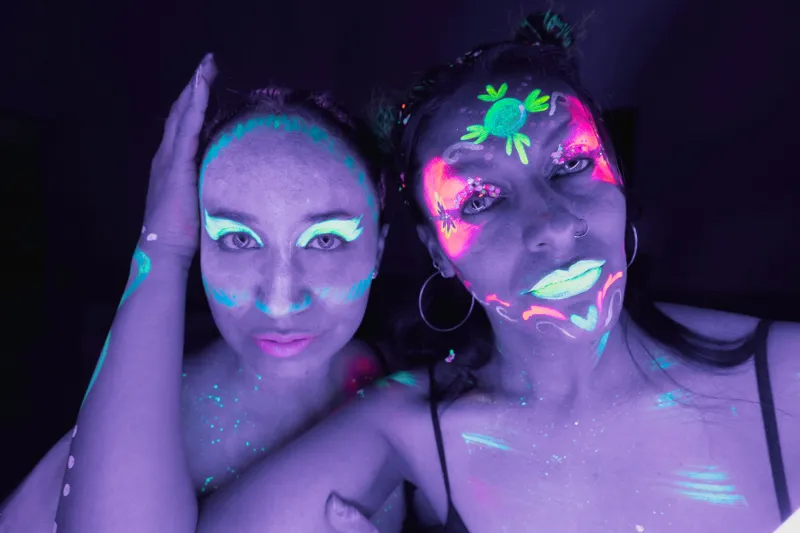
When the UV hits, a second city appears. Neon koi swimming through the brickwork. A hand-drawn transit map with stops that don't exist. Signatures and in-jokes rendered in a violet language the daytime mural never mentions.
"People walk past this wall every day and see one painting," says Dez, the crew's de facto organizer, who asked to be identified by his tag only. "Somebody walks past at night with the right light — a club flyer, a flashlight from the party store, whatever — and they see two. That's the whole trick."
The Second Layer
The technique isn't new, but the underground around it has gotten organized. UV-reactive paints — fluorescent pigments that stay nearly invisible under normal light but blaze under ultraviolet — have been drifting from stage-set supply houses and Halloween prop shops into the hands of graffiti writers and muralists for a few years now. The good stuff isn't cheap. A quart of quality invisible-clear fluorescent paint can run three to five times the price of standard exterior acrylic, and it doesn't always play nice with the base coats underneath.
"You learn the chemistry or you learn frustration," Dez says. "Some blacklight paint over dark primer just disappears forever. Over light primer, it pops. We test every wall with a swatch before we commit a single hour."
The crew's supply chain is a small, word-of-mouth economy: a theatrical lighting supplier in South Jersey who doesn't ask questions, a discount bin at a costume warehouse, occasional bulk orders split five ways through a group chat. Nobody's getting rich. Everybody's getting weird.
A Run in Real Time
The night we tagged along, the crew was four deep: Dez on the big shapes, a writer named Smalls handling the linework, and two newer hands — one cutting stencils, one holding the light rig and, in her words, "learning where the ladder goes."
The run started at 1 a.m. and the rules were simple. Everything invisible goes on last. Everything visible was already done, legally, with the shop owner's blessing. The UV layer, technically, lives in a gray zone — but because it's functionally undetectable in daylight, nobody's landlord has ever complained. The wall passes every inspection by being, in the light of day, exactly what it's supposed to be.
By 2:30, the koi were swimming. By 3:15, the fake transit map had acquired a station labeled with the crew's inside joke for a friend who moved to LA. By 4, they were packing tubes of paint into a hatchback and killing the blacklights, and the wall went back to being ordinary.
"Best part of the night," Smalls said, pulling away. "Right when it stops being visible to us too."
Does It Count If Nobody Sees It?
Here's the question that hangs over every glow run: what is a mural for? Street art has always negotiated with its audience, but this is a negotiation with a 99 percent no-show rate. The daytime mural serves the neighborhood. The ultraviolet layer serves — who? The crew? The one in a hundred people carrying a UV flashlight past a parking garage at 2 a.m.?
Dez has an answer ready, and he's clearly given it before.
"Most tags get buffed in a week. Most murals last five years, tops, before somebody power-washes the wall for condos. The invisible layer is the only part of the wall that's actually mine forever, because nobody knows it's there to remove it. It's the most permanent work I do and the least seen. Both of those things are the point."
There's a lineage here, whether the crews claim it or not. Invisible ink is as old as writing itself — lemon juice, milk, the spy-craft of messages meant for one reader. What's changed is the infrastructure: cheap UV flashlights in every phone accessory bin, LED strips that turn any bedroom into a blacklight booth, and a generation of viewers already trained by QR codes and AR filters to assume there's a second layer under everything.
The Light Is Getting Cheaper
If the past decade of street art has been about adding digital layers to physical walls — scans, filters, projections — the blacklight crews are doing the opposite. No app. No update. No server that dies and takes the artwork with it. Just pigment, chemistry, and the right lamp. The second mural will outlast every platform.
Whether it outlasts the crew is another question. Invisible art relies on someone knowing where to point the light. Documentation is deliberately thin — the whole economy depends on these pieces staying semi-secret, passed between people who know to bring a flashlight.
As we left, the shop's security light clicked on over a wall that looked, once again, completely ordinary. Somewhere under the rowhouse skyline, a fake subway map was waiting for a reader who might never come.
Dez didn't seem bothered. "It's there," he said. "That's enough."
Grafedia followed this run with the crew's knowledge and the property owner's permission for the visible mural. Locations and identities are lightly obscured at the artists' request.