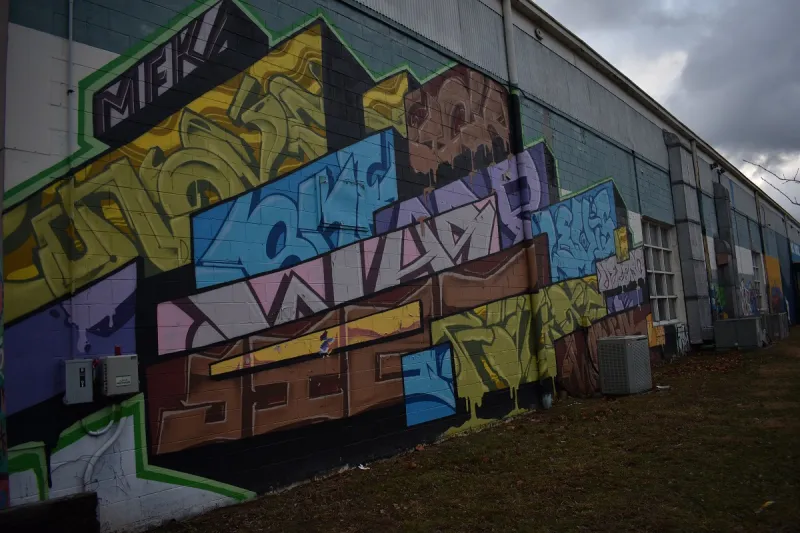
The Ledger Never Sleeps: How a Twenty-Year-Old Tag Came Back to Haunt a Guy Named Marcus

Photo by Photo by Jeff Kauffman on Unsplash on Unsplash
Marcus did the thing they tell you to do. He aged out. Quit painting trains at twenty-three, got a certificate in HVAC, moved out to Tucson, started showing up to jobs on time. For eleven years the only person who knew his old name was a guy in Phoenix who owed him $80.
Then a background check pulled up a municipal graffiti database entry from 2009. Photo, handstyle, charge. Searchable. Indexed. Older than his niece.
The Street Used to Forget
Here's the thing about getting up in, say, 2003: the memory of the street was analog. Buffed walls, faded stickers, a cop's spiral notebook that maybe three people ever saw. If you quit, the evidence physically eroded. Rain was your lawyer. Time was your co-defendant walking away scot-free.
That whole arrangement is over, and it didn't go out with a bang. It went out with an API.
A patchwork of graffiti tracking software — some sold to cities, some to transit agencies, some to insurance adjusters who've apparently decided a handstyle on a loading dock is an actuarial event — now lets anyone with a login query fifteen years of someone's adolescence in seconds. Upload a photo of a tag, get a match. Some of these platforms market themselves with the breezy language of every other SaaS product: dashboards, repeat-offender heat maps, "intelligence-led enforcement." Nobody's marketing the other feature, which is that the data never goes away and nobody ever gets it expunged.
Your Tag Is a License Plate Now
The comparison that keeps coming up in my conversations with writers isn't to criminal records. It's to license plates. A tag functions as a persistent identifier — that's literally the point of it, the whole culture runs on recognition. What's changed is who can read it and at what scale.
A veteran bomber in Chicago put it to me like this: "We invented a tracking system for ourselves. They just added a search bar."
And the search bar has ambitions. A few municipalities have piloted image-matching tools that cross-reference graffiti photos with other databases, and vendors at urban-security conferences have floated facial recognition add-ons with the enthusiasm of people describing a brunch feature. Most of these pilots stay pilots — budgets, lawsuits, public blowback — but the direction of travel is obvious, and writers feel it before the press releases confirm it.
The Collateral Paper Trail
What actually happens to people like Marcus? The cases cluster in unglamorous places:
- Job screenings. A vandalism misdemeanor from 2008 that a human hiring manager would shrug at becomes a red flag when it arrives pre-packaged with photos and a "repeat offender" score attached.
- Housing. Landlord screening services aggregate far more than evictions, and graffiti database hits have a way of migrating into them.
- Visa and border issues. Ask any writer who's tried to enter Canada with a vandalism conviction. The border doesn't care that you paint murals now. The border has a printout.
The bitter irony, and every writer I spoke to mentioned it unprompted: the same cities that deny them leases will hire them for mural programs the moment the paint is sanctioned. Legality is the only variable. The database doesn't distinguish between the two resumes.
So Does Anyone Quit Anymore?
Here's the question the subculture is quietly arguing about in group chats and freight-yard parking lots: if permanence is guaranteed, what happens to the risk calculus of getting up?
The old math was simple — thrills versus a fine and a court date. The new math includes a tail of consequences with no statute of limitations, a debt that compounds for decades. You'd expect that to scare people off the walls entirely.
It hasn't, mostly. What it's changed is behavior. Writers are savvier about faces on camera. Some have shifted toward sanctioned walls and legal spots, which the databases can't do much with. Others have gone the opposite direction, treating anonymity as a craft in itself — no face, no consistent handle, deliberate style drift. The tag as burner phone.
And a smaller group is doing something genuinely new: organizing. There are loose efforts — part mutual aid, part archivist grudge — to document when and where writers' data gets shared between agencies and private vendors, the same FOIA muscle that's been flexed against ShotSpotter and license plate readers, pointed at graffiti registries. It's early. It's scrappy. It's very street-art-meets-digital-media, which is to say it's exactly the kind of experiment this site was built to cover.
The Wall Forgets. The Cloud Doesn't.
Street art has always been a conversation with impermanence. The buff, the rain, the next writer going over you — the whole culture was a negotiation with forgetting. Databases ended that negotiation unilaterally.
Marcus is fine, for the record. He lawyered up, got the record sealed in his state, and learned the hard way that "sealed" and "deleted from a vendor's server in Delaware" are two very different things. He still does HVAC. He still won't tell me his tag.
"Doesn't matter," he said. "It's in there. Somewhere it's always 2009 and I'm sixteen and it's three in the morning."
The street used to have a memory like a friend's — fuzzy, forgiving, mostly gone in a decade. Now it has a memory like a spreadsheet. And spreadsheets, as every writer is learning, are for sale.