Static Bloom: Notes on Murals Built to Break the Camera
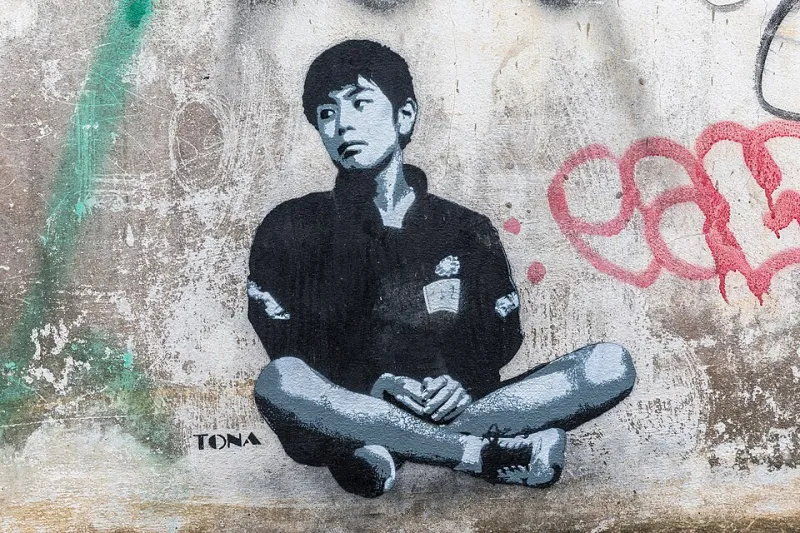
Photo: Fons Heijnsbroek, CC0, via Wikimedia Commons
The first thing you notice on Woodward is that nothing looks wrong. Brick, primer, a wide band of pale gray, a second band of finer gray, a third finer still — like someone taped off a gradient and then got bored halfway through. It reads as unfinished. You pull out your phone to check the light, and the wall detonates.
The whole thing goes to static. Not a subtle shimmer — a full, crawling interference bloom, bands sliding across the screen as you tilt, the surface boiling into a checkerboard that doesn't exist in the alley. Step back six inches and it resolves. Step forward and it's a fractal again. Put the phone down and it's just gray stripes on brick, quiet as a parking lot at 6 a.m.
That's the point. The crew calls the piece Null Set and they've asked me not to name the block, which is a very 2026 way to talk about a wall that's already on street view.
The Physics Is the Medium
The trick is old, cheap, and unbelievably fussy. Two high-frequency grids — one painted, one applied as a vinyl overlay — spaced just close enough that the camera's sensor can't resolve them. The sensor samples the pattern at its own limit and produces a phantom pattern that was never painted. Moiré. Anyone who ever photographed a CRT television knows the flavor.
What's new is that people are doing it on purpose, with math.
"You're not painting a picture, you're painting a sample rate," says a muralist out of Cleveland who goes by Hess and has done four of these in the last eighteen months. "Everything is a compression artifact waiting to happen. I just pick which artifact."
Her kit is not romantic. A laser level. A lot of masking. A stack of printouts with line frequencies penciled in the margins. She photographs each pass with three different phones to see what each one will do. The iPhone flattens it one way, a Pixel with HDR cranked does something else entirely, and the older Androids with weaker processing just smear the whole thing into soup. Same wall, three different lies.
Glass Beads and Bad Intentions
The moiré pieces get the attention, but the meaner work is happening in paint chemistry. Retroreflective pigments — the glass-bead stuff that makes road signs glare — send light straight back at the source. On a sunny afternoon your phone's meter reads the wall, decides the world is ending, and crushes everything around it to black. The mural survives. The photo becomes a white smear with a dark halo.
One Detroit collective has been mixing beads into their highlight layers for two seasons. Their walls look, in person, like a normal, slightly chalky figurative piece. On camera they look like a nuclear test. Comments on the geotag are a war between people insisting it's a filter and people insisting the original artist is a hack. Neither group has seen it.
There are quieter versions too. A dichroic film that shifts color depending on the angle of the light rather than the angle of the phone — which means a still photo picks one arbitrary frame out of a continuous, walking experience and calls it the piece. A mural in Houston uses an infrared-blocking topcoat that reads as flat brown to a camera and as eight distinct tones to a human eye standing in afternoon heat. Someone spent real money on that brown.
The Timer Problem
Then there's the light.
A handful of walls now carry programmable LED elements that only activate in narrow windows — usually between 11 p.m. and 1 a.m., sometimes shorter, sometimes tied to a lunar calendar or a specific temperature. Outside the window the wall is inert. Inside it, the piece assembles itself.
Which creates a weird ethical problem for anyone with a camera. The window exists so that some people can catch it. It's not a refusal of documentation, it's a rationing of it. There's a whole genre of comment thread now where people trade the exact minute a wall goes live, like birders. The crews know. Some of them leak the schedule on purpose.
"I don't want it unphotographable," Hess says. "I want it unphotographable casually. There's a difference between a wall you can't shoot and a wall you have to show up for."
What an Uncapturable Wall Is Actually For
The cynical read is that this is a stunt, and honestly, some of it is. A piece that breaks the camera gets shared because it breaks the camera. The failure is the thumbnail. You can build a whole following on being the wall that won't render.
But spend an afternoon with the people making them and a different argument surfaces, one that's less about the feed and more about what the feed has quietly done to the wall.
A mural used to be a thing you had to be near. Now it's a thing you scroll past in under two seconds, cropped by a stranger, color-graded by an algorithm, geotagged to a corner that may not exist anymore. The documentation outlives the paint. Some of these artists have watched their best work get flattened into a 1080-by-1350 rectangle and called done.
Making the capture fail is a crude way of restoring the difference between the two. It doesn't stop the photo. It just guarantees the photo is wrong — that there's a gap between what's on the wall and what's on your screen, and that gap can only be closed by standing in front of it.
The Bill Comes Due
Here's the part nobody wants to say out loud: these walls are expensive. Reflective pigment costs more than paint. Moiré overlays get vandalized, peel, and have to be reprinted. LED installs need power and permission and insurance. And the grants that pay for them are, almost without exception, awarded to artists with a documented audience — meaning a feed.
So the anti-capture mural is not actually anti-capture. It's capture on the artist's terms: a wall that photographs badly but interestingly, that rewards the person who shows up and punishes the person who screenshots.
Which might be the most honest position street art has taken in years. Not a refusal of the phone. Just a demand that the phone work a little harder.
Null Set is still there. I checked on the way out, phone in pocket, and it was the quietest thing on the block — gray stripes, good light, nothing happening. If you're in the neighborhood, go look. Leave the camera in the car for the first ten minutes. It'll be worth more than the shot.