Bitrate Burns: The Crews Designing Murals for the Feed, Not the Block
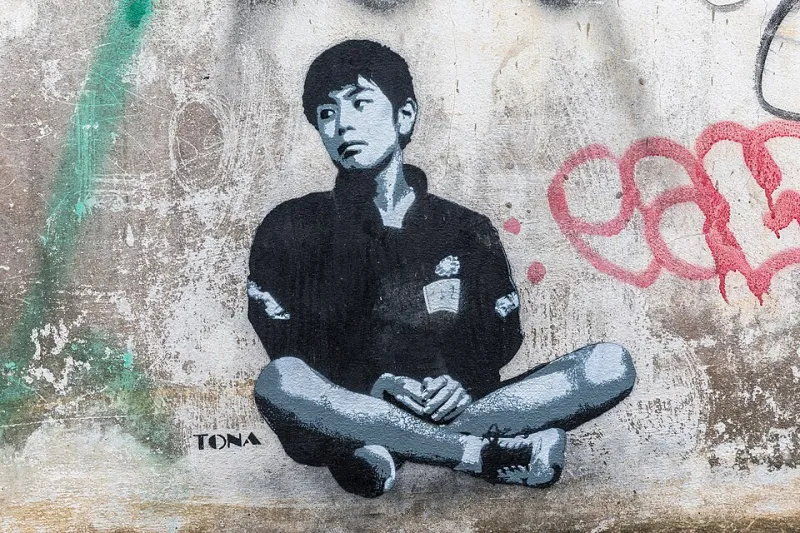
Photo: Tona, CC BY-SA 4.0, via Wikimedia Commons
On a Thursday night in Chicago's Pilsen neighborhood, a mural crew is arguing about a shade of orange that will never be seen by anyone standing on the sidewalk. They are looking at a phone. The orange is on a wall sketch, but the sketch has been photographed, uploaded to a burner Instagram account, screenshotted, and re-cropped until the color has gone slightly flat and the edge of a letterform has started to smear. The crew calls this the compression test. If the orange does not survive that trip through the feed, it does not go on the wall.
This is not a gimmick. It is a working method, and it is spreading. In Chicago, Atlanta, and Oakland, painters are building murals backward from the phone camera: choosing contrast over nuance, big shapes over fine linework, and colors that hold their identity after the bitrate chews them up. The wall is still the wall. But the feed is where the piece will actually live.
The Compression Test Is the New Sketchbook
The Chicago crew, who asked me not to use their names because one of them is still on probation for an old tag, has a routine. They sketch in a cheap notebook, then shoot the page with an older iPhone that one member keeps specifically because its camera is not great. That bad camera matters. It approximates the worst-case phone in a stranger's hand. They upload the image to a private account, let the app compress it, screenshot the result, and pin both versions side by side. The rule is simple: if the detail disappears in the compressed version, it was never detail. It was decoration for people standing close enough to care.
What gets cut is revealing. Thin outlines vanish. Subtle gradients turn into banded stripes. Small text becomes a rumor of text. What survives is high contrast, hard edges, and shapes that read at thumbnail size. One painter described it as 'designing for the squint.' Another called it 'painting for the people who will never stand here.'
What Survives the Feed
In Atlanta, a crew working near the BeltLine has turned the test into a checklist. They look for three things: silhouette, contrast, and a single focal shape. If the mural cannot be understood as a silhouette at arm's length, they simplify it. If the contrast collapses when the image is compressed, they push the darks darker and the lights lighter. If there is no single shape that owns the frame, they add one.
That last rule has changed how they compose. A mural used to be built like a stage set: foreground, middle ground, background, details tucked into corners. Now it is often built like a logo: one dominant shape, a limited palette, and negative space that does not fill with noise when the image gets squeezed. The result can look blunt up close. Up close, a lot of new murals look like they were painted with a house brush. From a phone, they look intentional.
Oakland crews are taking a different route. One group is experimenting with what they call 'bitrate burns'—deliberately high-contrast patterns that create moiré effects when photographed. The wall looks almost aggressive in person. On a screen, it vibrates. The effect is not accidental. They are painting for the camera's failure modes, using compression artifacts as a material. It is the street-art equivalent of writing a song for a bad car speaker.
The Wall as Source File
There is a quiet shift in this work. The mural is no longer only the finished object. It is a source file. The wall is where the image is stored at high resolution, but the phone is where it gets distributed, cropped, filtered, and captioned. Painters are starting to talk about 'the export'—the version of the piece that most people will see. The export has different rules. It rewards symmetry, readable shapes, and colors that do not muddy when compressed. It punishes subtlety.
That does not mean every artist is happy about it. One Atlanta painter told me she resents the idea that the feed gets to decide what a wall is for. She still paints for the block first. But she admitted that she now checks the phone before she signs off. 'You can pretend the camera is not there,' she said. 'But the camera is always there. So you might as well make it work for you.'
A Finished Piece Is a Thumbnail Now
The crews I met are not abandoning craft. They are adding a step. The compression test sits alongside priming, sketching, and sealing. It is another constraint, like a crooked wall or a landlord who wants the piece gone by Monday. And like any constraint, it produces a style. The new murals are bolder, flatter, and more legible at small sizes. They are designed to survive the trip from brick to bitrate.
Whether that is good for street art is a separate question. The wall has always been a compromise between the artist and the city. Now the phone is part of the city. It is the thing that carries the work to people who will never smell the paint or see the sidewalk. The JPEG may not be the real wall yet. But for a growing number of painters, it is the wall that counts.