Depth Charge: The LA Mural That Only Comes Together in Portrait Mode
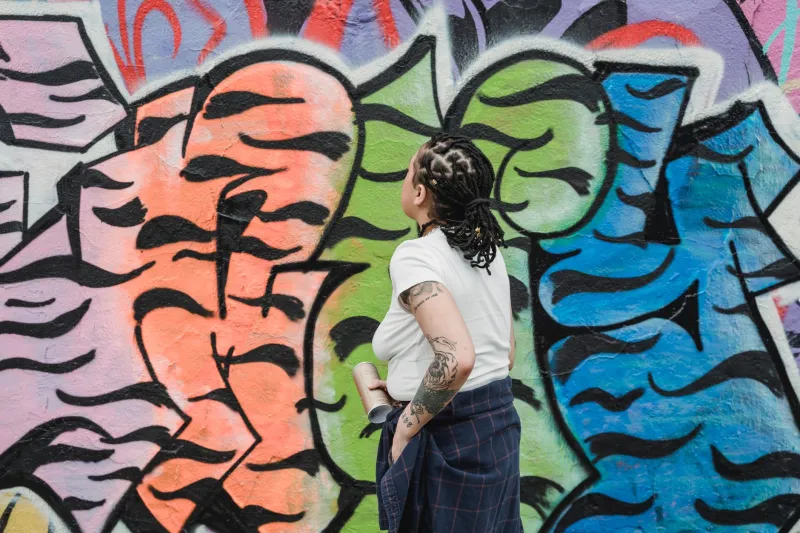
On a warm November morning along the LA River, a crew is arguing about blur. Not the kind that comes from a bad spray cap or a long night, but the synthetic kind—the creamy, fake background falloff your phone adds when you tap Portrait mode. The wall in front of them looks, to anyone standing on the sidewalk, like a deliberate mistake: a chain-link silhouette in the foreground, a wash of muted midtones behind it, and a hard-edged color field in the back. Nothing lines up. Nothing resolves. That is the point.
The Wall Looks Wrong on Purpose
The crew calls the piece Middle Ground, and it is one of a small wave of US murals designed for computational depth rather than human eyes. The foreground elements are painted with sharp contrast and saturated edges. The background is a flat, high-contrast field. The middle ground—the part a phone’s depth map tends to blur—is a muddy lattice of mid-value shapes that, in person, reads like unfinished business. In Portrait mode, those shapes collapse into bokeh, and the foreground and background snap into alignment. A face appears. Or a hand. Or, depending on where you stand, a second wall behind the wall.
“We are not painting for the retina anymore,” says one of the artists, a muralist who has spent the last decade working in the Arts District and Boyle Heights. “We are painting for the segmentation mask.” That sentence sounds like a joke until you watch the crew test it. They hold up three phones—an iPhone, a Pixel, a Samsung—and move slowly along the wall. Each device produces a slightly different blur. Each device reveals a slightly different third image. The wall is not one artwork. It is a family of artworks, depending on the lens.
Designing for a Depth Map
The technical logic is straightforward, even if the result is not. Phone portrait modes do not create optical bokeh the way a fast lens does. They estimate depth using dual cameras, LiDAR, or software segmentation, then blur the areas they believe are background. The estimate is imperfect. Hair, chain-link, palm fronds, and painted edges are notorious sources of error. For muralists, those errors are a medium.
“You can paint into the mistake,” says a phone-camera engineer who consulted on the project and asked not to be named because she was not authorized to speak for her employer. “If you know the segmentation model is going to struggle at a certain edge, you can make that edge carry information. The blur becomes a filter, and the filter becomes part of the composition.” She calls the approach “computational depth caching”—a way of pre-loading the image with cues the phone will interpret as layers. The crew calls it “painting for the algorithm.” Both descriptions are accurate.
The wall itself is a collaboration between painters and a small team of AR and camera-testing folks. They spent two weeks on site, but most of the work happened before the first can popped: test prints, phone mockups, and a lot of standing around saying, “Okay, now squint and imagine the middle is gone.” The final palette is intentionally ugly up close—gray-green, dusty rose, a yellow that reads as caution tape. From ten feet away, it looks like a wall that gave up. From behind a phone, it looks like a portrait.
The Portrait Mode Test
The crew’s daily routine includes a “portrait pass”: walk the wall at a fixed distance, shoot a short video in Portrait mode, and review the footage on a laptop. The goal is not perfection. It is consistency across devices and light. Morning sun flattens the middle ground. Afternoon sun adds texture. Overcast days are the best, because the phone has fewer shadows to misinterpret. “We are not chasing a universal image,” one artist says. “We are chasing a reliable glitch.”
That glitch is also a business problem. Murals are usually commissioned as permanent or semi-permanent public works. This one is designed to be viewed through a device that changes every year. A phone that segments perfectly today may segment differently after the next software update. The crew has already noticed that one Android model blurs the foreground chain-link into the background, collapsing the whole composition into mush. They are considering a second pass with brighter edge highlights—a kind of firmware-friendly overpainting.
What the Passersby See
On the sidewalk, reactions split cleanly. A cyclist stops and asks if the mural is finished. A dog walker says it looks like “a test wall.” A group of teenagers, all holding phones, get it immediately. One of them taps Portrait mode, gasps, and says, “Oh, it’s a face.” She is right. The third image is a stylized face—not a portrait of a person, exactly, but a face-shaped arrangement of negative space that appears only when the middle ground blurs. It lasts for a second, then vanishes when she lowers the phone. “That’s creepy,” her friend says. “Do it again.”
That is the strange new contract of street art in a mobile feed. The wall has two audiences: the people who walk past it and the people who scan it. The first audience sees abstraction, maybe confusion. The second sees a reveal. Neither is wrong. The mural is not trying to trick anyone; it is trying to make the act of looking visible. When the middle ground disappears, so does the assumption that a wall is a stable image. What remains is a composition that only exists because a phone decided what to throw away.
The Third Image Is the Point
By late morning, the crew is packing up. The wall looks, if anything, more unresolved than when they started. A jogger slows down, squints, and keeps moving. The artists do not seem bothered. They have spent the morning watching people point their phones at a wall and see something that was not there a second before. That is the piece: not the paint, not the bokeh, but the moment the two systems—human vision and computational depth—disagree long enough to produce a third thing. The wall will stay up for six months. The third image will change with every phone update. Both of those facts are part of the work.