Crop Marks on Concrete: The Quiet Rise of the Vertical-First Mural
In a converted warehouse just off the Los Angeles Arts District, a muralist steps back from a half-finished wall, lifts a phone on a gimbal, and checks the frame. Not the whole wall. The frame. She is looking for the place where the image will land inside a vertical video: center-weighted, legible at thumbnail size, with enough dead space at the top for a caption and enough contrast at the bottom to survive a row of on-screen buttons. The wall itself is almost an afterthought. The crop is the composition now.
This is not a trend piece about murals being photographed. Street art has been photographed since someone first brought a camera to a train yard. What is different in 2026 is that a growing number of murals are being designed for the phone first and the street second. Call it the vertical-first mural: a wall composed around 9:16, built to be seen through a feed, and increasingly judged by how well it stops a thumb.
The 1080-by-1920 Sketchbook
Walk into a working muralist's studio in Chicago or Denver's RiNo district and you may find fewer wide-format sketches and more vertical storyboards. Artists are mocking up walls inside a phone-shaped rectangle. They place the hero image—a face, a hand, a bird, a piece of type—inside the safe zone. They push secondary details toward the upper corners, where a viewer's eye travels after the first half-second. They leave negative space where a platform's interface will sit.
"The wall has always had rules," says one muralist who has painted commissioned pieces in Brooklyn, Austin, and Miami. "Light, scale, architecture, the neighbors. Now there's another rule: what does this look like at arm's length on a six-inch screen?"
The practical vocabulary is changing. Artists talk about crop reveals—details that only appear when the camera pans or the viewer walks to the side. They talk about thumb stops, the first frame that has to work before anyone decides to keep watching. They talk about color calibration for phone cameras, which can turn a subtle gradient into mud and a saturated orange into a screaming beacon. Some are painting with higher contrast on purpose, not because the wall needs it, but because the feed does.
What the Crop Cuts
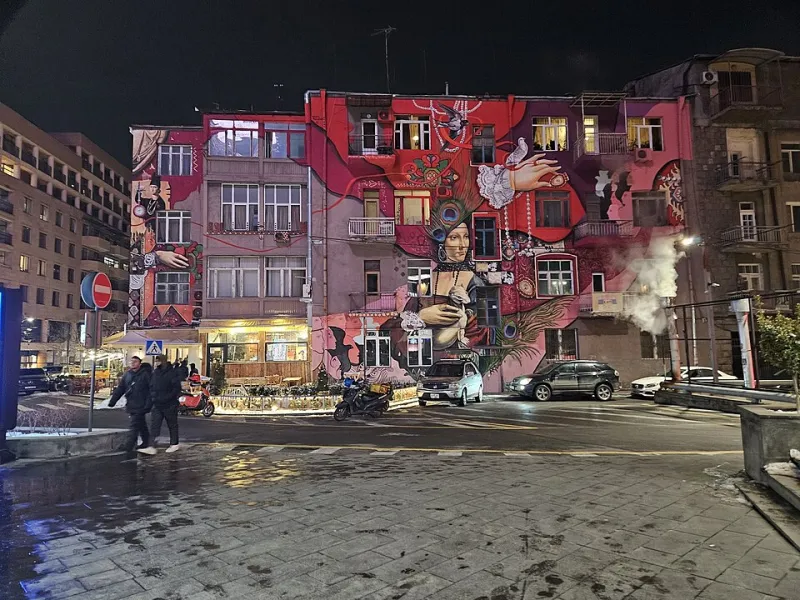
The losses are not abstract. A mural is a horizontal medium by tradition and by architecture. It lives across a wall, beside a doorway, under a fire escape, around a corner. It is read at walking speed. The vertical frame slices all of that into a central column. Side panels vanish. Neighboring murals disappear. The relationship between the image and the building—the thing that makes a wall piece site-specific—gets cropped into a backdrop.
That has consequences for scale. A 40-foot wall designed for a phone can end up with one oversized focal point and a lot of filler. The viewer at street level sees a giant eye and a field of half-resolved color. The viewer on the feed sees a perfect thumbnail. Both are real audiences, but only one is shaping the design.
There is also the question of sequence. Murals used to unfold. You walked past them and the image changed. A vertical-first composition often delivers its entire payload in the first frame. That is good for retention and bad for discovery. The wall becomes a poster for itself.
The Set Piece Problem
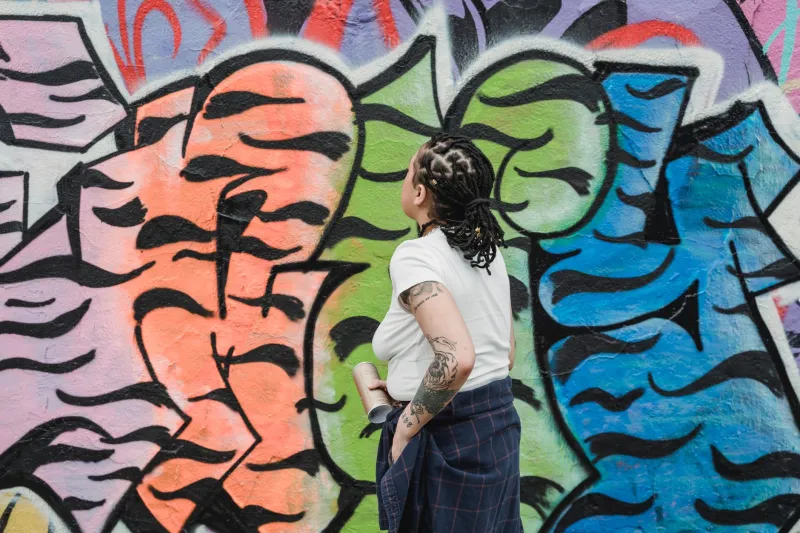
Maybe the most uncomfortable shift is social. A mural designed for the feed is designed to be stood in front of. Not read, not walked past, not lived beside—documented. The wall becomes a set piece, and the person in front of it becomes the subject. The art is the background.
Artists feel this in commissions. Landlords and brands want shareable walls. Developers want a backdrop for events. A mural that resists the phone can be harder to sell, even if it is better for the block. Some painters are negotiating for what they call off-camera sections: passages of the wall that only make sense in person, details too small for the feed, textures that flatten on screen. It is a small rebellion, but it is a real one.
The best vertical-first murals are not stupid about this. They use the phone frame as a discipline, not a surrender. They put the hero image in the crop and hide the local references outside it. They paint for the thumb and then reward the feet. In Philadelphia, one crew has been adding narrow side panels that read like footnotes—visible only when you stand at an angle. In Brooklyn, a muralist has been painting the top corners with details that look like noise on a phone but resolve into a second image from the sidewalk. The feed gets its thumbnail. The block gets its wall.
A Place Still Has Edges
None of this means the mural is dying. It means the mural is being re-authored by the crop. The phone is now the first viewer, and first viewers shape everything. The question is whether artists and the people who commission them will keep designing for the edges that the phone cannot see.
A wall is not a screen. It has texture, scale, weather, neighbors, and a life that continues after the post stops circulating. The vertical-first mural can be a genuinely new form—part street piece, part motion study, part set design. But if the feed becomes the only measure, the mural becomes content. And content, by design, is always ready to be cropped again.
Stand on the sidewalk in front of one of these walls and you can feel the tension. The image is legible, bright, centered, ready for the camera. Then you step to the side and notice the parts that were never meant for you: a thin line of text, a neighbor's tag, a color that only works in the afternoon light. The phone misses them. The block does not. That is the trade-off now—not whether murals will be seen on screens, but whether they will still be built for the places that hold them up.