Your Style Is a Prompt Now: Street Artists vs. the Training Set
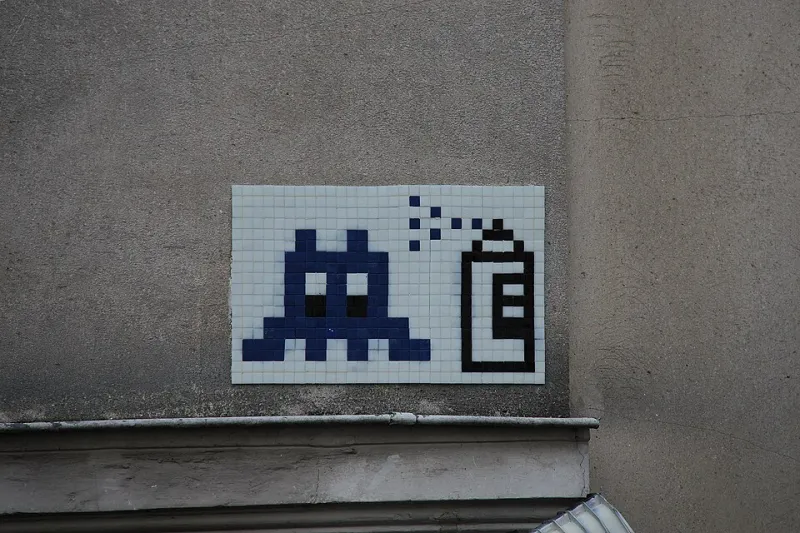
Photo: Basile Morin, CC BY-SA 4.0, via Wikimedia Commons
Type "graffiti mural, colorful, urban style" into any major image generator and you'll get something competent in about eight seconds. Type in a specific artist's name and — depending on the platform's current filtering mood — you might get something that looks unsettlingly like their actual hand: their letter structure, their color instincts, their weird little habit of leaving the drips off the left side.
For a community that built its entire ethic around getting up, paying dues, and earning a name on walls, this is not a technical nuisance. It's a philosophical ambush.
The Gray Zone Nobody Painted
Let's be honest about the ambiguity first, because the easy outrage misses it. Graffiti culture has always been a culture of copying — writers bite styles, flip them, argue about it, and move on. Whole eras of New York and West Coast lettering evolved through open theft with attribution disputes attached. So when an AI model ingests forty years of flicks from freight trains and highway overpasses and recombines them, is that different from a young writer biting a burner from a 1990s magazine?
Ask a room full of writers and you'll get a room full of arguments. But the distinction most keep circling back to is scale and consent. A biter copies one style, gets called out, and lives or dies by reputation. A model copies everything at once, belongs to nobody, and answers to a corporation.
"Biting is a conversation," as one Oakland-based muralist put it to me. "This is a photocopy machine that never has to face the wall."
When the Prompt Comes for You
The most tangible harm isn't abstract. Several US-based artists told me they've found generated images in the wild — on NFT marketplaces, in fast-fashion ad mockups, in a mall mural pitch deck — that read as unmistakably "their style" without their name attached or a dollar attached to their name.
One Los Angeles lettering artist, who asked not to be named because of ongoing legal conversations, described the experience of watching a client's AI-generated "mood board" that was, functionally, her portfolio run through a blender. "They weren't even hiding it," she said. "They called it 'inspiration material.'"
The legal reality is bleak for artists. Style isn't copyrightable in the US — only fixed, specific expression is. A generated image that evokes your hand without reproducing any single piece likely violates nothing a court will recognize. Which leaves the streets to invent their own remedies.
Watermarks, Glaze, and Going Dark
The countermeasures fall into two camps: defensive and hostile.
The defensive camp is watermarking and glazing — embedding visual or computational noise into photos of new work before posting, so that scraped images degrade as training data. Some crews have stopped posting high-res images entirely, restricting documentation to low-res crops or in-person viewing only. It's a genuine cultural loss: the photo documentation that turned graffiti from a regional scene into a global one is being voluntarily shrunk.
The hostile camp is more fun. Inspired by research like the Glaze and Nightshade projects, some artists are deliberately poisoning their uploads — images that look normal to humans but corrupt model training if scraped. Others have taken to embedding garbage text, adversarial patterns, or misleading metadata into documentation photos. One Midwest freight writer told me he now overlays a repeating pattern of fake artist signatures on his photos, "so whatever model eats it learns to sign the wrong name."
Homage, Theft, and the Next Wall
Here's my honest take, since this is an opinion piece: the artists are right, and the "but culture has always borrowed" defense is a dodge. Borrowing in graffiti came with accountability — a name, a reputation, a wall you had to defend. Generative models built on street art photography took the aesthetic and deleted the accountability. That's not homage. That's extraction with the serial numbers filed off.
And the deeper irony is hard to miss. Street art spent decades being commodified without consent — ripped off by brands, whitewashed by developers, licensed out from under its makers. AI training sets are just the newest, most efficient version of an old American tradition: taking culture from the street and selling it back to it.
The crews watermarking and poisoning their work aren't being paranoid. They're doing what writers have always done when the rules changed: adapting, tagging the new surface, making it theirs. The machines wanted the canvas. The canvas is fighting back — one poisoned pixel at a time.