Lights, Walls, Vanishing Acts: Inside America's Projection Bombing Underground
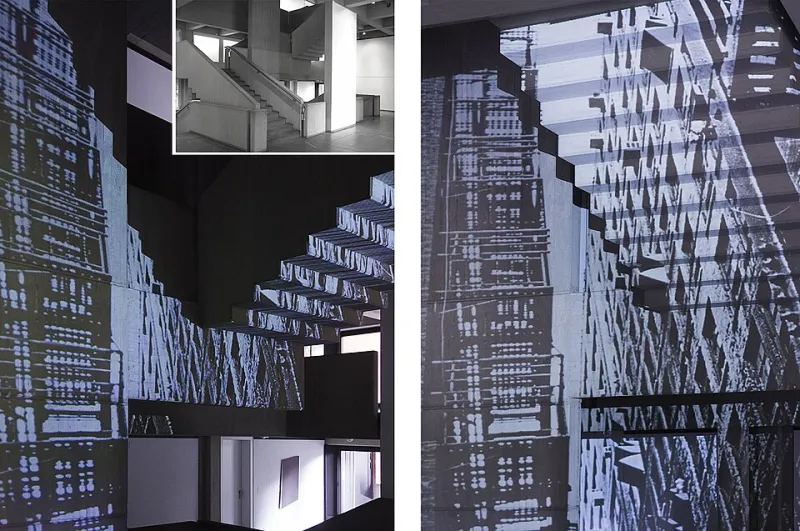
Photo: Gezeigtes Werk: Rita Rohlfing Fotograf des gezeigten Werkes: Rita Rohlfing, CC BY-SA 4.0, via Wikimedia Commons
The best time to see a projection bomb is also the worst time to be looking for one. These pieces appear for minutes, sometimes seconds, on buildings you've walked past a thousand times — then the generator shuts off, the crew packs up, and the wall goes back to being a wall.
You missed it. But 40,000 people on Instagram didn't.
That's the core trick of digital graffiti: the work is temporary, the documentation is forever. We spent months following five crews across the country who've turned this paradox into a practice. Here's who they are and how they operate.
1. The Ghost Lumen Society — Chicago
Veterans of the scene, Ghost Lumen have been bombing the West Loop since before TikTok made everything a video. Their signature is architectural: they map the facades of old industrial buildings and project animations that "repair" them — ghosted windows light up, missing signage flickers back to life, a long-demolished neon sign burns bright for ninety seconds.
Legally, they occupy gray territory. Projection itself isn't vandalism in most Illinois statutes — there's no paint, no damage — so their encounters with police tend to end in confusion rather than citations. "A cop once asked us if we had a permit," one member told us. "We said for what? There's nothing on the wall."
2. Static Bloom — Los Angeles
Static Bloom started as film students with a borrowed projector and an obsession with the LA River. Now they run one of the most-watched projection accounts on the internet, famous for botanical animations — enormous blooming flowers, root systems crawling up parking structures — thrown onto concrete in the Arts District at 2 a.m.
Their rule: never the same wall twice in a month, never more than ten minutes on site. The whole rig fits in two backpacks: a short-throw projector, a battery pack, a media player. Setup takes under four minutes. They've never been stopped.
3. Hex & Haze — Philadelphia
Philly's contribution to the scene is lo-fi and proud of it. Hex & Haze favor cheap projectors and hand-drawn animations scanned frame by frame — the aesthetic is closer to a photocopied zine than a Hollywood VFX reel. Their most infamous piece transformed the blank face of a Fishtown warehouse into a giant, blinking eye that tracked pedestrians on the sidewalk below (pre-recorded, but it didn't feel like it).
They also run the scene's best-kept secret: an unlisted map of "clean walls" — buildings with no cameras, no residents, and landlords who've either looked the other way or, in three cases, become fans.
4. Circuit Orchard — Austin
Circuit Orchard blur the line between projection and AR. Alongside their physical light bombs, they drop location-based AR pieces — digital sculptures pinned to specific coordinates, visible only through your phone. A projection might announce a location; the AR piece that lives there is permanent, invisible, and free.
It's a clever legal hack. There's nothing on the property to remove, so there's arguably nothing to prosecute. Property owners, when they notice at all, mostly don't. One downtown parking garage owner told us he thinks the AR piece "anchored" to his wall is "kind of cool, I guess."
5. Night Signal — Brooklyn
Night Signal treats the whole borough as a broadcast schedule. Their projection runs are timed and themed — a night of animated poems on the bridges of the Gowanus Canal, a coordinated hour where six walls across Bushwick lit up with the same looping animation of a rising sun.
Their following is the largest of any crew we covered, and they've monetized it carefully: commissioned projections for music venues and festivals fund the unauthorized ones. It's the oldest street-art bargain — legal work pays for the illegal kind — updated for the projector era.
Why Vanish at All?
Every crew we spoke to said the same thing: the ephemerality isn't a limitation, it's the point. Paint gets buffed in weeks. A projection exists for as long as someone chooses to keep it alive, and no longer. The wall never has to say yes.
And the mobile feed changes the math entirely. A piece that lives for eight minutes can be clipped, shared, and replayed forever. The audience isn't the block anymore — it's anyone with a phone. In that sense, digital graffiti might be the only street art form that gets bigger after it disappears.
Keep your eyes on the walls after midnight. And if you see a building bloom, film it. That's the only place it's going to exist tomorrow.