Lease, Paint, Vanish: The Overnight Crews Turning Dead Billboards Into a 60 MPH Gallery
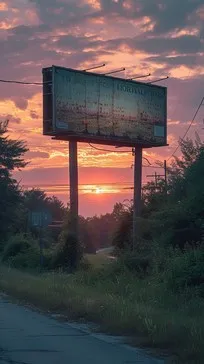
Photo: weathered billboard beside american interstate highway at dusk, via images.stockcake.com
Somewhere outside Amarillo, at 6:40 on a February morning, a semi driver doing the speed limit glanced up and saw a forty-eight sheet billboard that had advertised a personal injury attorney for the better part of a decade now covered in something else entirely: a giant, sun-yellowed hand holding a single key, painted in what looked like house paint but wasn't. By the time the driver reached the next gas station and posted about it, someone in the comments already had the geotag.
That's how it works now. The painting is the first half. The pin drop is the second.
The Loophole Nobody Read
Here's the part that surprises people: none of this is vandalism. The billboard economy runs on churn — advertisers let leases lapse, panels sit blank or rot with sun-bleached vinyl for months, and outdoor advertising companies are generally happy to rent the face to anyone who pays the (often surprisingly modest) short-term rate. A handful of crews figured out that 'anyone' includes them.
Call it the expired-panel economy. A dying billboard on a rural stretch of I-40 might lease for less than a month of storage unit rent. The painters pool money, sign whatever paperwork the outdoor company hands them, and then treat the surface like what it technically is: the biggest canvas they'll ever legally stand in front of.
'We're not sneaking,' one painter who goes by Haze told me over a shaky phone call from a truck stop. 'We have a receipt. The highway patrol has driven past us working. You can't get more above board than holding a ladder on the shoulder of a federal highway at two in the morning.'
Overnight Logistics
The production reads like a he movie with a permit. Scouting happens weeks ahead — sightlines, speed of traffic, where the sun hits at commute hours. Designs are prepped in sections on polytab or primed paper at a warehouse, then pasted up fast, because nobody wants to be on a catwalk over interstate traffic when the sun comes up. A four-person crew can transform a panel in under five hours.
The constraint is the medium. At 60 miles per hour, a driver gives your work maybe two seconds. So the pieces are brutalist by necessity: one image, high contrast, no fine print. It's a format older than the internet — the Burma-Shave logic of the roadside — executed by people who grew up on graffiti production lines.
The Map Is the Real Gallery
What separates this from a bunch of sign painters with a sense of humor is the layer on top. Every finished panel gets geotagged and dropped on a shared mobile map, usually under a handle, sometimes with a scan code pasted discreetly into the corner of the piece. Drivers who notice a painting can find its listing: coordinates, crew name, sometimes a photo of the paste-up crew mid-hoist.
The result is a distributed exhibition with no venue, no opening, no press release — just thousands of commuters a day becoming accidental visitors. One crew's map listing for a piece outside Kansas City logged over 9,000 views in three weeks, almost all from people who'd physically driven past it first.
The billboard, in other words, finally has a comment section.
When Advertising Catches On
The friction is coming, and the painters know it. Outdoor companies are waking up to the fact that 'art face' rentals are a product, and products get priced. There's already chatter about tiered rates — commercial advertisers paying one number, and 'creative content' paying another. A few state outdoor advertising associations have started asking whether art-leased panels technically violate the terms of their federal highway permits, a question that could get very boring and very consequential fast.
Some crews have leaned into the tension, selling a single panel a year to a brand to fund six noncommercial pieces — a move that's already causing arguments in group chats about whether that's sustainability or surrender.
The Last Public Canvas?
There's a case to be made that the interstate is the only truly shared visual space left in America. Museums gatekeep. Social feeds algorithm-gatekeep. But a billboard on I-80 belongs to whoever looks up — truckers, nurses on night shift, a kid in the backseat of a Corolla. Nobody curates it. Nobody can.
The painters leasing dead panels understand this better than anyone. They're not tagging the highway. They're renting it, fair and square, one expiring lease at a time — and leaving a pin behind so the drive remembers what it saw.


